
Every organisation is different and processes personal data in different ways, so you need to make sure that the processing activities described in your RoPA match how you process personal data in practice.
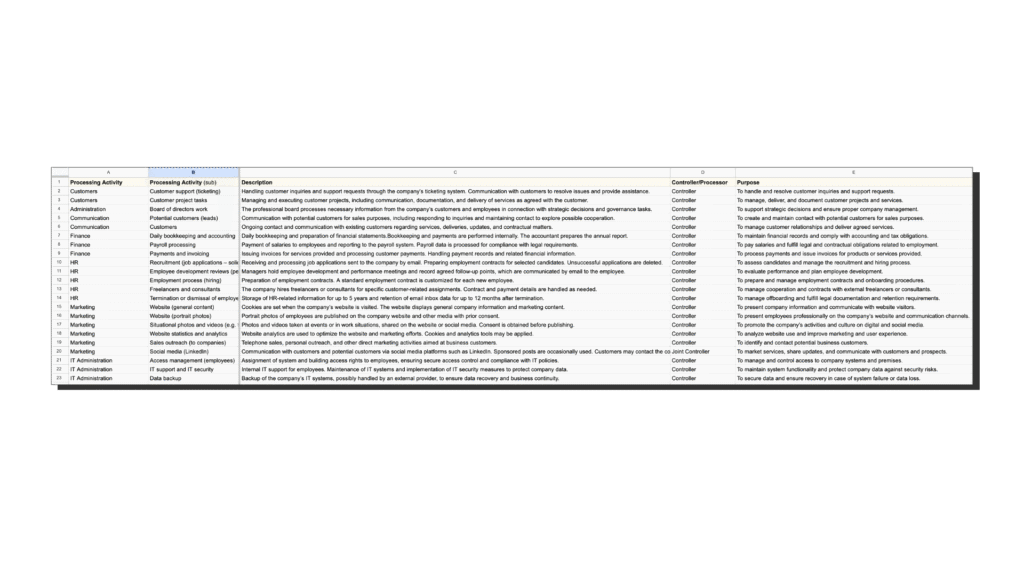
If you are unsure what a processing activity is, take a look at our article where we describe 200 examples of processing activities. For those who are not familiar with the GDPR requirement to maintain an up-to-date RoPA, we suggest you read our full guide on Records of Processing Activities. This guide also explains how to document your activities so that your RoPA accurately reflects your actual processing.
Download RoPA Template (.xlsx)
To get started with the RoPA template you can go ahead and download the Excel file here.
Download the file and open it in Excel or Google Sheets. Each row in the table represents one processing activity, for example, Customer support or Payroll processing.
Review the example entries
The template comes pre-filled with example processing activities. These are typical for many businesses and illustrate how to fill in the fields. You can use them as inspiration or keep, edit, or delete them depending on whether they apply to your organisation.
Add your own processing activities
For each activity where you handle personal data, add a new line. Examples include:
- Recruiting new employees
- Managing customers and suppliers
- Website analytics and marketing
- Payroll and accounting
Each activity should describe one clear purpose for the processing of the personal data, and ideally the activity should align with a business process. This enables you to connect the compliance documentation to real world actions.
Store it safely
Save the RoPA in a secure internal location with limited access. It must be available to your management and to the supervisory authority if requested.
RoPA Benefits
If you are serious about GDPR compliance, then the RoPA is your friend. It’s your overview of how personal data moves through the company and helps you stay in control in practice while also documenting your compliance.
It shows you where data is stored, who has access to it, and why it’s being processed. With that overview, it becomes much easier to handle data requests, solve problems quickly, and stay ready if anyone asks about your compliance.
It also helps you make sure each activity has a clear legal basis and that you don’t keep data longer than needed. You can use it to plan when information should be deleted and how that happens in practice.
Your RoPA also proves that you take privacy seriously. If a customer, partner, or authority asks how you handle personal data, you can simply show them. It makes your work transparent and builds trust.
GDPR Software (RoPA)
If our Excel RoPA template is not enough for you, we suggest taking a look at the GDPR software by .legal. They offer a free forever plan where you can map your RoPA and use some of their prefilled templates. This is a great option for beginners who need guidance, as well as for larger organisations looking for a professional way to manage their GDPR compliance.
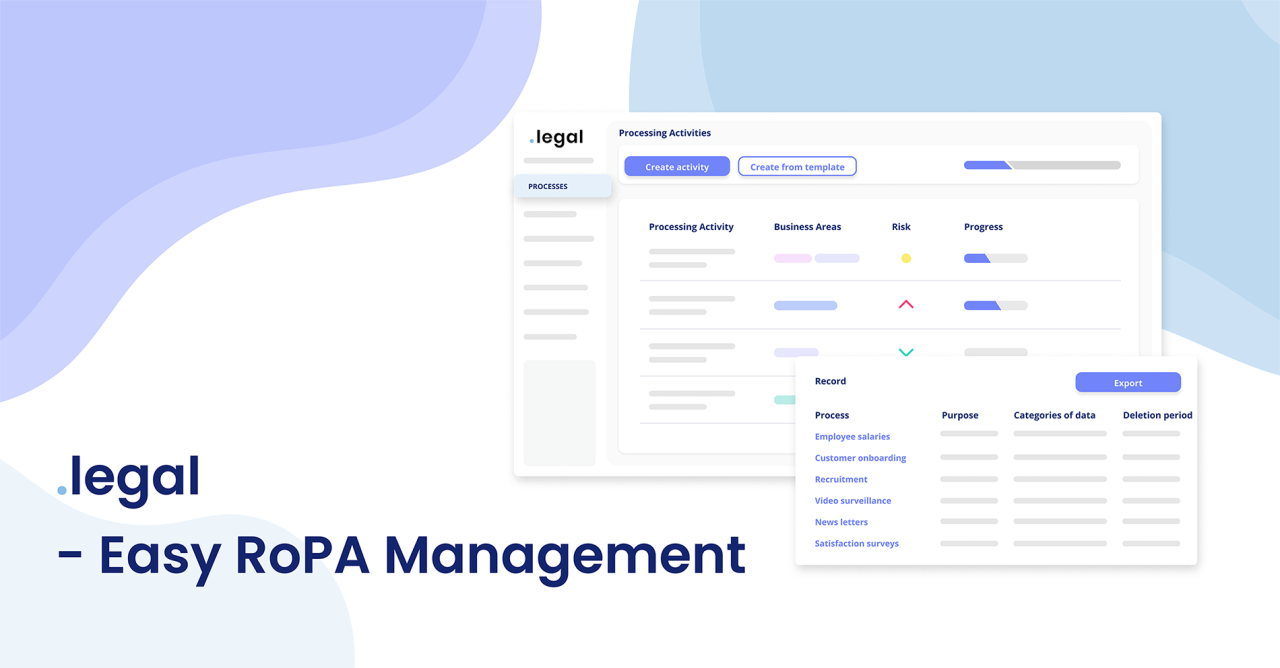
GDPR software enable better compliance – it is as simple as that.


